I’M AT MY WIT’S END. 👉Estou no meu limite/ estou sem saber o que fazer. HE GOT A “FIVE-FINGER DISCOUNT” ON THOSE SUNGLASSES. 👉Ele roubou os óculos de sol. I’M EXHAUSTED. I’M GONNA CRASH. 👉Estou exausta. Vou dormir. HE GHOSTED ME. 👉Ele parou de me responder. I’M UNDER THE WEATHER. 👉I’m feeling sick (estou me sentindo mal). I’M DOWN. 👉I agree (eu concordo).
🔹 I’M AT MY WIT’S END.
Meaning: 👉 Estou no meu limite. 👉 Não sei mais o que fazer. 👉 Estou desesperado(a) / sem saber como resolver a situação.
It means you have tried different things and can’t think of any other solution.
💡 “wit” here refers to your ability to think, reason, or find a solution. So, literally, it is like saying: “I have reached the end of my ability to figure this out.”
Examples
I’ve tried everything. I’m at my wit’s end. → Tentei de tudo. Estou no meu limite.
I’m at my wit’s end with my computer. It keeps crashing! → Estou no meu limite com meu computador. Ele não para de travar!
She’s at her wit’s end trying to get her kids to behave. → Ela está no limite tentando fazer os filhos se comportarem.
We’ve been looking for a solution for weeks. We’re at our wit’s end. → Estamos procurando uma solução há semanas. Não sabemos mais o que fazer.
I’m at my wit’s end. Nothing I do seems to work. → Estou no meu limite. Nada do que faço parece funcionar.
🗣️ Very natural variations
You can change the possessive depending on the subject:
I WAS LET GO. 👉I was fired (fui demitido(a)). WHAT GOES AROUND COMES AROUND. 👉Aqui se faz, aqui se paga. I AM GOING TO GIVE HIM A PIECE OF MY MIND. 👉Eu vou dizer pra ele o que penso (com raiva). OFF THE TOP OF MY HEAD. 👉De cabeça/ sem pensar muito. I WON’T TAKE THE BLAME FOR THAT. 👉Eu não vou levar a culpa por isso. CAN WE BOTH AGREE THAT THIS IS WRONG? 👉Dá pra gente concordar que isso está errado?
I WAS LET GO
“I was let go” means “I was fired” or “I lost my job.”
However, let go is often a softer and more polite way to say fired. It can also suggest that the decision was made by the company because of restructuring, budget cuts, or other business reasons—not necessarily because the employee did something wrong.
Examples:
I was let go last week. 👉 Fui demitido(a) na semana passada.
Unfortunately, they let me go after five years with the company. 👉 Infelizmente, eles me demitiram depois de cinco anos na empresa.
A lot of employees were let go because of budget cuts. 👉 Muitos funcionários foram demitidos por causa de cortes no orçamento.
She was let go when the company downsized. 👉 Ela foi demitida quando a empresa reduziu o quadro de funcionários.
He was let go, but it wasn’t because of poor performance. 👉 Ele foi demitido, mas não foi por causa de baixo desempenho.
The company had to let several people go. 👉 A empresa teve que demitir várias pessoas.
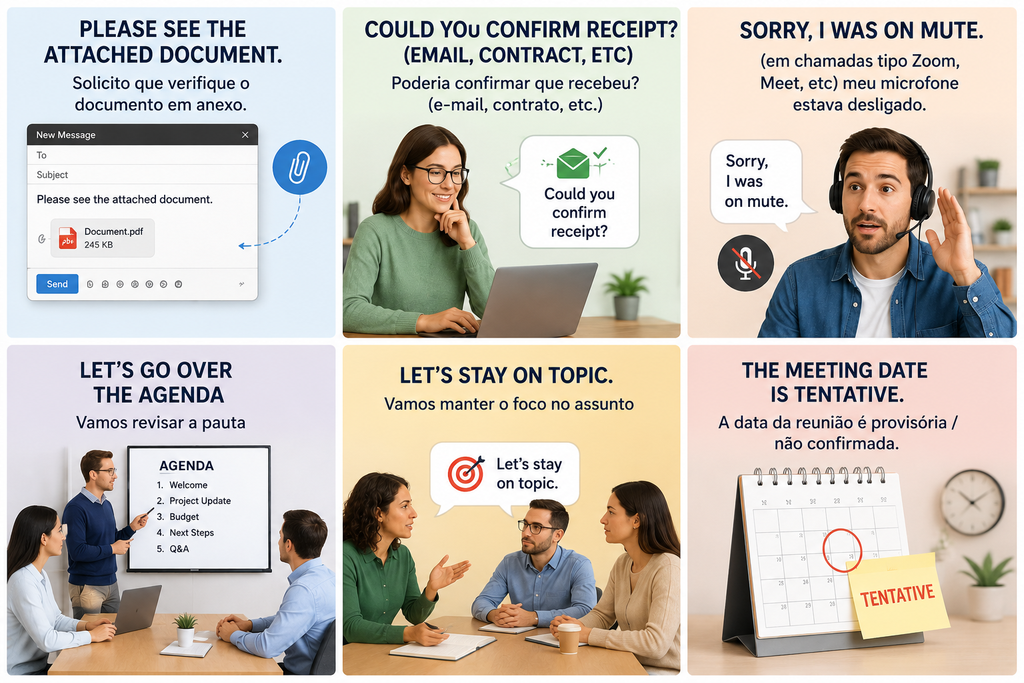
PLEASE SEE THE ATTACHED DOCUMENT. 👉 Solicito que verifique o documento em anexo. COULD YOU CONFIRM RECEIPT? (EMAIL, CONTRACT, ETC) 👉 Poderia confirmar que recebeu? (e-mail, contrato, etc.) SORRY, I WAS ON MUTE. 👉 (em chamadas tipo Zoom, Meet, etc) meu microfone estava desligado. LET’S GO OVER THE AGENDA. 👉 Vamos revisar a pauta LET’S STAY ON TOPIC. 👉 Vamos manter o foco no assunto THE MEETING DATE IS TENTATIVE. 👉 A data da reunião é provisória / não confirmada.
📎 “Please see the attached document.”
Meaning: A polite and professional way to say:
Please look at the document I attached.
Portuguese:
Por favor, veja o documento em anexo.
Examples:
Please see the attached document for more information.
Please see the attached report before tomorrow’s meeting.
Please see the attached contract and let me know if you have any questions.
Similar expressions
I’ve attached the document.
Please find the attached document.
Attached is the document you requested.
See the attached file for details.
Vocabulary
attachment = anexo
attached document = documento anexado
attached file = arquivo anexado
💡 “I’ve attached the document” sounds more natural and conversational, while “Please see the attached document” is slightly more formal and common in business emails.
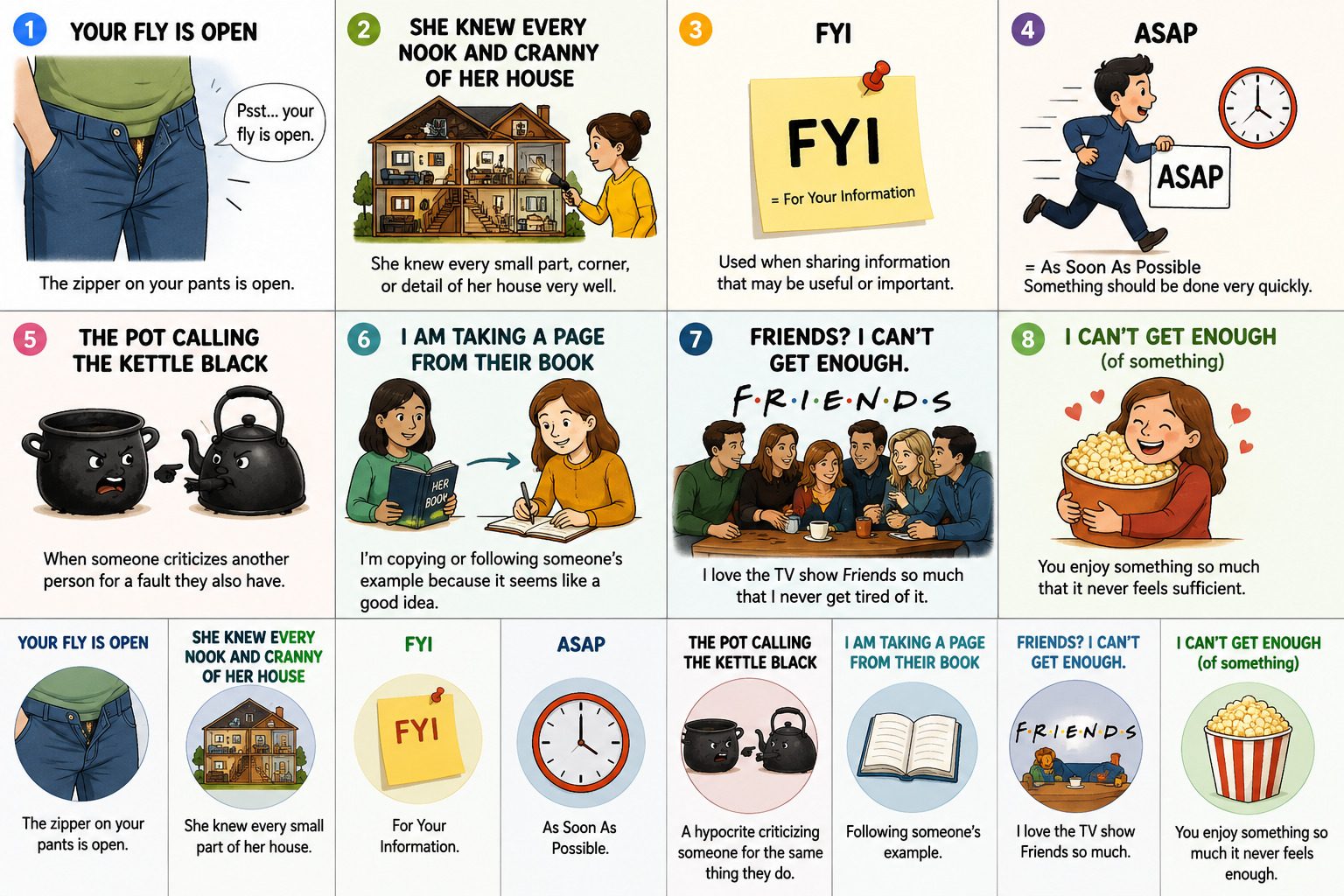
YOUR FLY IS OPEN. Seu zíper está aberto. SHE KNEW EVERY NOOK AND CRANNY OF HER HOUSE. Ela conhecia cada cantinho de sua casa. FYI / ASAP For Your Information / As Soon As Possible THE POT CALLING THE KETTLE BLACK. O sujo falando do mal lavado. I AM TAKING A PAGE FROM THEIR BOOK. Estou aprendendo com eles FRIENDS? I CAN’T GET ENOUGH. Friends? Não consigo parar de assistir
“Your fly is open” 👖
“Your fly is open” means that the zipper on someone’s pants is undone/open. It’s an informal expression, and people usually say it quietly to avoid embarrassing the person.
Vocabulary
fly = the zipper area on pants/jeans/trousers
Examples
“Hey, your fly is open.”
“I walked around all day with my fly open!”
“Before the interview, someone told me my fly was open.”
“Check your fly before you go on stage.”
More natural / softer ways to say it
People often avoid saying it directly. They may say:
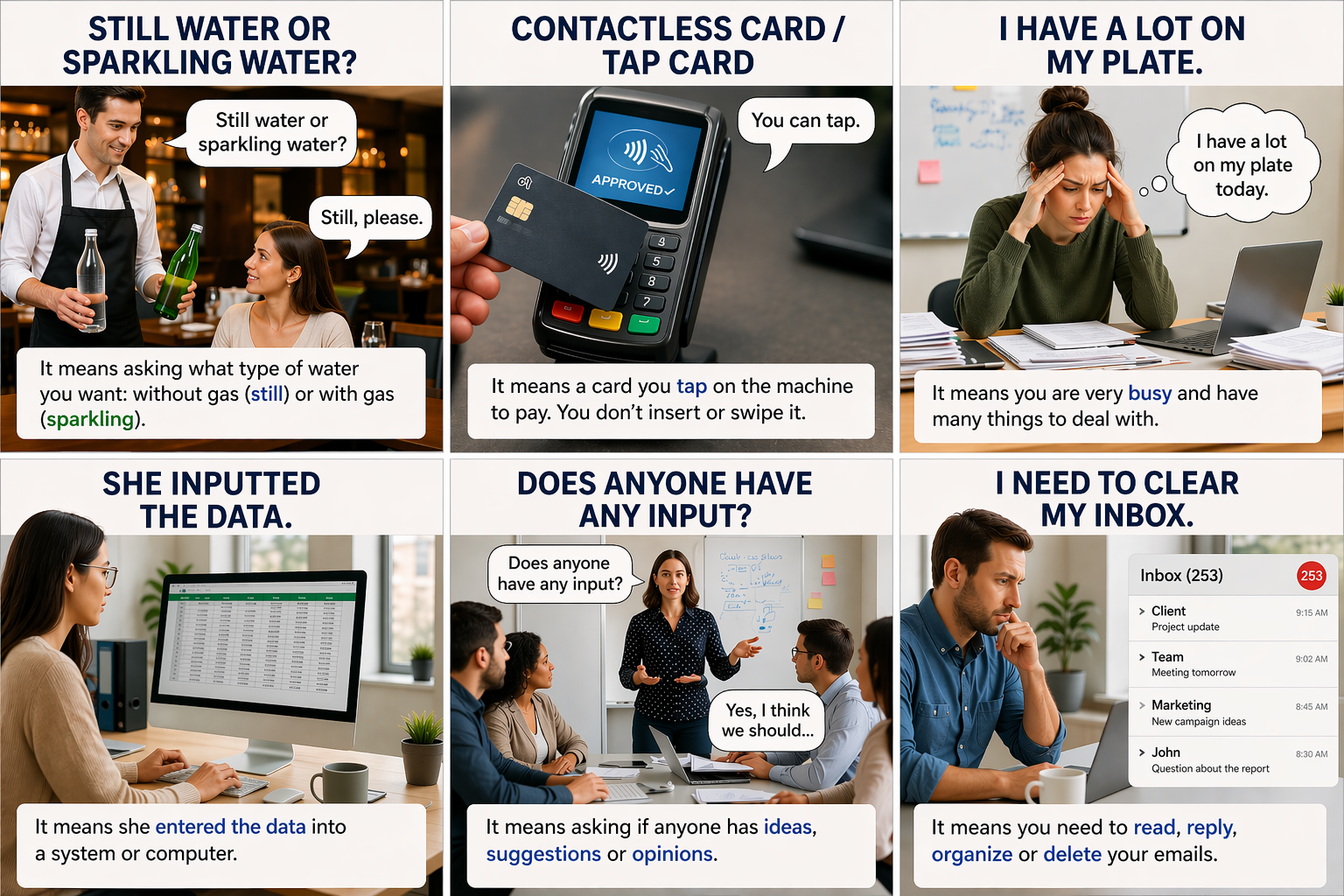
CONTACTLESS CARD/TAP CARD Cartão de aproximação STILL WATER OR SPARKLING WATER? Àgua sem gás ou com gás? I HAVE A LOT ON MY PLATE. I’m very busy (estou muito ocupado). SHE INPUTTED THE DATA. Ela colocou a informação. DOES ANYONE HAVE ANY INPUT? Alguém tem alguma ideia ou opinião para compartilhar? I NEED TO CLEAR MY INBOX. Preciso responder os meus e-mails.
CONTACTLESS CARD/TAP CARD
Contactless card” or “tap card” is a payment card you don’t insert or swipe. You just tap it on the reader to pay. It uses NFC (wireless) technology.
Contactless card = more formal term
Tap card / tap-to-pay card = everyday language
Examples
“You can use a contactless card for small purchases.”
“Just tap your card on the machine.”
“Do you accept tap cards?”
“I paid with my contactless debit card.”
“Tap your card — no PIN needed for amounts under $50.”
Also used with phones & watches
“I used tap to pay on my phone.”
“It’s contactless payment — no need to insert the card.”
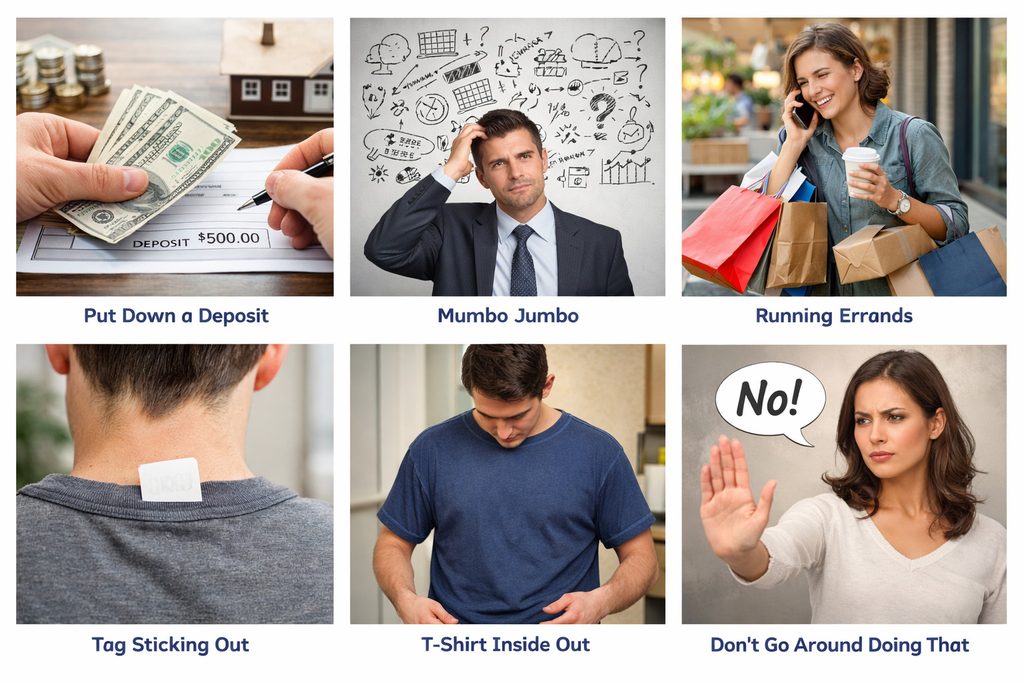
YOU HAVE TO PUT DOWN A $500.00 DEPOSIT, AND THAT’S JUST FOR STARTERS. Você tem que dar $500,00 de sinal só pra começar. THAT WAS FULL OF MUMBO JUMBO (MUMBLE JUMBLE). Estava cheio de blá-blá-blá. I WAS RUNNING ERRANDS. Eu estava resolvendo coisas na rua. I DON’T GO AROUND DOING THINGS LIKE THAT. Não ando por aí fazendo essas coisas. YOUR TAG IS STICKING OUT. Sua etiqueta está aparecendo. YOUR T-SHIRT IS INSIDE OUT. Sua camiseta está do avesso.
🔹 Expression:
“You have to put down a $500 deposit, and that’s just for starters.”
🔹 Meaning:
“put down a $500 deposit” = pay an initial amount of money before getting something (like renting, buying, booking)
“that’s just for starters” = that’s only the beginning; more (usually more money, effort, or requirements) will come after
👉 So the full sentence means: You need to pay $500 now, and that’s only the beginning—there will be more to pay or do later.
🔹 Important note:
In English, we usually write:
$500.00 (not $500,00)
🔹 Tips:
Don’t say: ❌ “five hundred dollars deposit”
Correct: ✅ “five hundred dollar deposit” (adjective form)
🔹 More examples:
Buying a car
You’ll need to put down $2,000, and that’s just for starters.
Planning a wedding
The venue costs $5,000, and that’s just for starters.
Starting a business
We’ve already invested $10,000, and that’s just for starters.
Travel expenses
The flights alone cost $1,200—and that’s just for starters.
Home renovation
Fixing the roof will be $3,000, and that’s just for starters.
I COULDN’T PUT MY FINGER ON IT. Eu não conseguia explicar. WHAT DO YOU KNOW! Quem podia imaginar! Olha só! SHEHIT THE GROUND RUNNING! Ela chegou arrebentando/começou com tudo. LET’S PLAY IT BY EAR. Vamos deixar rolar. IT’S A LONG SHOT, BUT I NEED TO TRY. É improvável/difícil/um tiro no escuro, mas preciso tentar. HE DID A QUICK FIX ON THE LAMP. Ele consertou a lâmpada com uma gambiarra.
👉 “I couldn’t put my finger on it.”
Meaning: You feel or notice that something is different, strange, or wrong — but you can’t clearly explain exactly what it is.
It’s used when you have a vague feeling or intuition, but you can’t identify the specific reason.
🔎 Simple Explanation
It means:
“I know something is going on… but I can’t explain what exactly.”
🗣 Examples
About a person There’s something different about her today. I can’t put my finger on it.
About a problem The project isn’t working properly, but I can’t put my finger on the issue.
About a feeling I felt uncomfortable during the meeting, but I couldn’t put my finger on why.
About appearance Did you change something? I can’t put my finger on it, but you look different!
About a place This restaurant feels strange tonight. I can’t quite put my finger on it.
💬 Mini Story Example
When Denise walked into the classroom, everything seemed normal. The students were quiet, the lights were on, and the lesson plan was ready. But something felt off. She looked around and thought, “I can’t put my finger on it… but something isn’t right.”
Five minutes later, she realized — she had forgotten her laptop charger!
LET’S CALL IT A DAY. Vamos encerrar por hoje. IT’S A PIPE DREAM. É um sonho impossível. CUTTING A LONG STORY SHORT… Indo direto ao ponto. I’M PARTIAL TO VANILLA ICE CREAM. Eu gosto de sorvete de baunilha. TO TEACH YOUR GRANDMOTHER TO SUCK EGGS. Ensinar o padre a rezar a missa. WHY ARE YOU MAKING SUCH A FUSS? Por que você está fazendo toda essa confusão?
“Let’s call it a day”
Meaning: This expression means to stop working or doing an activity for now, usually because:
you’re tired 😮💨
you’ve done enough for today
it’s late
continuing wouldn’t be productive
It doesn’t mean the task is finished forever — just for today.
🕔 Very common at work, meetings, classes, or study sessions.
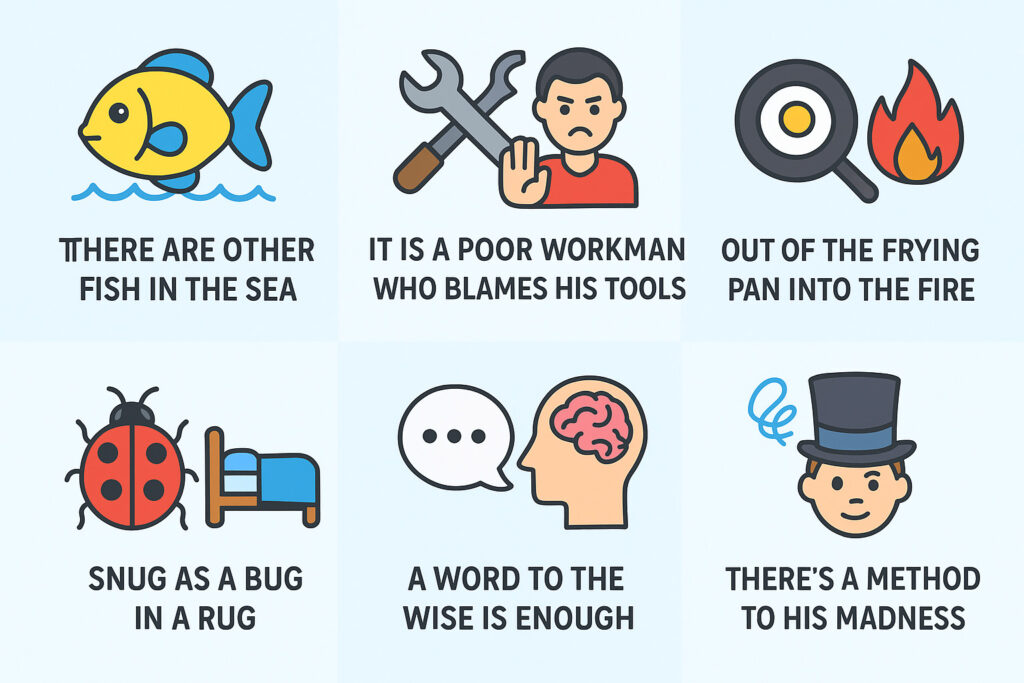
THERE ARE OTHER FISH IN THE SEA. Haverá outras oportunidades. THERE’S A METHOD TO HIS MADNESS. Ele é mais esperto do que pensa. IT IS A POOR WORKMAN WHO BLAMES HIS TOOLS. Não culpe outra pessoa por seus erros. OUT OF THE FRYING PAN TO THE FIRE. De mal a pior. SNUG AS A BUG IN A RUG. Está super confortável. A WORD TO THE WISE IS ENOUGH. Para um bom entendedor, meia palavra basta.
Gustavo Decleve’s contribution
🐟 THERE ARE OTHER FISH IN THE SEA
Meaning: It means there are plenty of other opportunities, people, or possibilities, especially after a disappointment. Most commonly, it’s used to comfort someone after a breakup, rejection, or something that didn’t work out, reminding them that better options still exist.
✅ Examples
After a breakup: “I know you’re sad, but don’t worry — there are other fish in the sea.”
After not getting a job: “You didn’t get the position? That’s tough, but there are other fish in the sea.”
After a friendship ends: “If she doesn’t value you, there are other fish in the sea who will appreciate you.”
After missing an opportunity: “You didn’t buy the house in time, but there are other fish in the sea.”
Encouragement: “Don’t stress about this one chance. There are other fish in the sea.”
🧠THERE IS A METHOD TO HIS MADNESS
✅ Meaning
This expression means that even if someone looks chaotic, strange, or illogical, they actually have a plan or a purpose behind what they are doing. What seems like “madness” is actually organized or intentional.
It’s often used when someone’s behavior appears confusing at first, but then you realize it makes sense.